Project Proposal
Project Title:
Solar Pump Installation for Safe Drinking Water in Tharparkar District, Sindh, Pakistan
Implementing Organization:
[Your Organization Name]
Project Duration:
24 Months (2026–2028)
Project Location:
Selected Villages of District Tharparkar, Sindh Province, Pakistan
Estimated Total Budget:
PKR 18,500,000 (USD 66,000)
- Background and Present Situation
Tharparkar District, located in the southeastern part of Sindh province, is one of the most drought-affected and water-scarce regions of Pakistan. The population depends largely on rain-fed agriculture and livestock, which are severely affected by frequent droughts. Access to safe drinking water remains the most critical challenge for the people, particularly for women and children who walk long distances daily to fetch water from deep wells or seasonal ponds.
Currently, most villages rely on hand pumps, dug wells, and small ponds, which often dry up during summer. Groundwater is available only at deep levels (250–300 feet) and is often saline or contaminated. Diesel-operated pumps are not sustainable due to high fuel costs and frequent maintenance issues.
- Problem Statement
- Lack of access to safe drinking water.
- Women and children spend 3–5 hours daily fetching water.
- High cost of fuel for diesel pumps.
- Poor water management and storage systems.
- Adverse impact on health, education, and livelihood due to water scarcity.
The situation demands a sustainable, renewable, and cost-effective solution for water extraction and distribution in remote villages. Solar energy provides a clean, affordable, and durable option to address this challenge.
- Project Objectives
Overall Objective:
To provide sustainable access to safe drinking water through the installation of solar-powered water pumps in water-scarce villages of Tharparkar.
Specific Objectives:
- To install 20 solar-powered water pumps with bore wells and tanks in 20 villages.
- To reduce the burden on women and children by providing nearby access to clean water.
- To promote renewable energy and environmental sustainability in rural communities.
- To improve hygiene, sanitation, and overall health outcomes in target areas.
- Project Activities
| S. No | Activity Description | Details |
| 1 | Baseline Survey | Conduct survey to identify suitable sites and assess water table. |
| 2 | Community Mobilization | Form Village Water Committees and train them for operation and maintenance. |
| 3 | Borewell Drilling | Drill bore wells up to 250–300 feet depth to reach clean groundwater. |
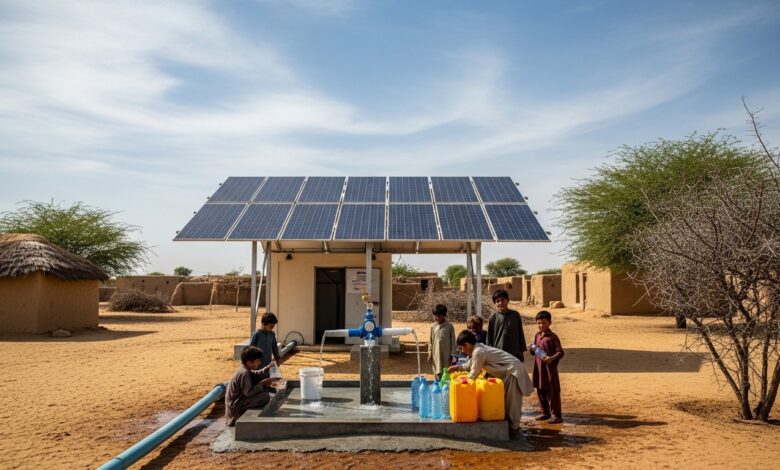
| 4 | Solar Pump Installation | Install solar pump machines with four (4) solar panels for each site. |
| 5 | Construction of Water Tank | Construct 8×9 ft reinforced cement concrete (RCC) water storage tank with tap stands. |
| 6 | Distribution Points Setup | Build 2–3 water collection points near homes and schools. |
| 7 | Training and Capacity Building | Train community caretakers for system maintenance. |
| 8 | Monitoring & Evaluation | Monthly monitoring of pump performance and water quality. |
- Expected Outputs
- 20 fully operational solar-powered water systems installed.
- Around 6,000–8,000 people gain access to safe drinking water.
- Reduced workload for women and improved school attendance for girls.
- Improved community hygiene and reduction in waterborne diseases.
- Strengthened community ownership and local maintenance capacity.
- Implementation Plan
| Phase | Activities | Duration |
| Phase 1 | Site selection, community mobilization, and baseline survey | 3 months |
| Phase 2 | Bore drilling and solar system installation | 12 months |
| Phase 3 | Construction of water tanks and tap points | 6 months |
| Phase 4 | Training, monitoring, and sustainability support | 3 months |
- Project Sustainability
The project promotes sustainability through:
- Use of renewable solar energy—no recurring fuel cost.
- Local community ownership through Village Water Committees.
- Simple maintenance and training for community caretakers.
- Use of high-quality materials ensuring long-term functionality.
- Estimated Budget
| S. No | Description | Unit | Quantity | Unit Cost (PKR) | Total Cost (PKR) |
| 1 | Borewell Drilling (250–300 ft) | Per Site | 20 | 250,000 | 5,000,000 |
| 2 | Solar Pump Machine | Per Unit | 20 | 180,000 | 3,600,000 |
| 3 | Solar Panels (4 per pump) | Set | 20 | 160,000 | 3,200,000 |
| 4 | RCC Water Tank (8×9 ft) | Each | 20 | 150,000 | 3,000,000 |
| 5 | Distribution Tap Points | Each Set | 20 | 50,000 | 1,000,000 |
| 6 | Training & Capacity Building | Lump Sum | – | – | 400,000 |
| 7 | Project Staff & Monitoring | Lump Sum | – | – | 800,000 |
| 8 | Transportation & Installation | Lump Sum | – | – | 500,000 |
| 9 | Contingencies (5%) | – | – | – | 1,000,000 |
| Total Estimated Cost | PKR 18,500,000 | ||||
| Equivalent in USD ($1 = 280 PKR) | USD 66,000 (Approx.) |
- Monitoring and Evaluation
The project will be monitored through:
- Monthly progress reports.
- Site visits by project engineers.
- Water quality testing every 6 months.
- Community feedback sessions.
- Final evaluation after 24 months to assess outcomes.
- Conclusion
The proposed Solar Pump Installation Project in Tharparkar District will significantly reduce water scarcity, promote women’s empowerment, and improve health and livelihoods. This project offers a sustainable, environmentally friendly, and community-driven solution to one of the most pressing issues in the desert region of Pakistan.