Micro Grant Application Form (Batch 111)
Project Title:
Mustard Oil Production Project
(Sarson ka Tail ka Ghana)
Total Budget: PKR 3,455,000
Applicant Name: Zulfiqar Ali Gopang
Village Rip, P.O Peeru Lashari, Taluka Talhar District Badin +92-336-3076110 / +92-0316-8707423
1. Introduction of District Badin
District Badin is located in the southeastern region of Sindh province, Pakistan. It is primarily an agricultural district with a rich history of farming, particularly rice, sugarcane, and oilseed crops like mustard. The district has a predominantly rural population, with limited industrial development. Infrastructure such as roads, electricity, and access to modern technologies remains a challenge, which affects the local economy and business growth.
2. Poverty in District Badin
Poverty is widespread in District Badin, with a significant portion of the population living below the national poverty line. Limited access to quality education, healthcare, and economic opportunities has perpetuated poverty in the district. Most households rely on small-scale farming or labor work, which often generates insufficient income. Consequently, the community faces challenges such as malnutrition, inadequate housing, and limited access to essential services.
3. Joblessness in District Badin
High unemployment rates are a critical issue in District Badin. Young people, particularly women and youth, struggle to find sustainable employment due to the lack of industries and skill development programs. The absence of local enterprises and small businesses has resulted in a shortage of income-generating opportunities. This situation contributes to social and economic instability in the district.
4. What is UNIDO – Paidar Grant Program
The United Nations Industrial Development Organization (UNIDO) – Paidar Grant Program is an initiative designed to support entrepreneurs and small businesses in establishing sustainable, incomegenerating projects. It provides financial assistance, technical guidance, and capacity-building support to applicants with viable business ideas. The program focuses on fostering industrial growth, improving livelihoods, and promoting local economic development.
5. What is the Aim of UNIDO – Paidar Grant Program
The primary aim of the UNIDO – Paidar Grant Program is to promote sustainable entrepreneurship and economic self-reliance in underprivileged communities. The program seeks to:
- Encourage small-scale businesses that have growth potential
- Reduce unemployment by creating job opportunities
- Improve local industrial and agricultural productivity
- Support innovative projects that can enhance income and livelihoods in rural districts like Badin
6. Project Overview: Sarson ka Tail ka Ghanna
Project Objective: To establish a small-scale mustard oil extraction and production unit in Badin, providing high-quality, pure mustard oil to local and regional markets. Budget Overview: Total budget of PKR 3,455,000 will cover:
- Purchase of machinery and equipment
- Raw material procurement (mustard seeds)
- Operational costs and workforce salaries
- Packaging and marketing Expected Impact:
- Creation of direct employment opportunities for local youth and women Boost local agriculture by providing a ready market for mustard farmers
- Enhance economic activity in Badin through production and sales
Business Idea, Market Gap Analysis, and Employment Generation
Our business, “Sarson ka Tail ka Ghana”, aims to establish a small-scale mustard oil extraction and production unit in District Badin. The project will produce high-quality, pure mustard oil for local and regional markets, ensuring a reliable supply of a staple cooking ingredient while promoting local agriculture.
Market Gap Analysis:Currently, Badin and neighboring districts rely heavily on imported or low-quality packaged mustard oil. Local farmers face difficulties in selling their mustard seeds at fair prices due to lack of processing facilities. This creates a significant market gap for locally-produced, high-quality mustard oil. By establishing a processing unit, we aim to bridge this gap, providing consumers with fresh, pure mustard oil while supporting local farmers with a ready market for their crops.
Employment Generation: The project will create direct and indirect employment opportunities in Badin. Initially, the unit will employ 8–10 skilled and semi-skilled workers for operations, packaging, and quality control. Additionally, it will generate indirect employment for 50–60 local mustard farmers and laborers involved in seed supply, logistics, and transportation. The inclusion of women in packaging and quality assurance roles will empower the local female workforce, promoting gender-inclusive economic growth.
This project not only addresses the market gap for high-quality mustard oil but also stimulates the local economy, enhances farmer income, and reduces unemployment in District Badin, aligning perfectly with the objectives of the UNIDO Paidar Grant Program.
Profile, Proposed Business Relevancy, and Experience
Our team has strong ties to District Badin’s agricultural sector, with experience in crop cultivation and smallscale processing. The proposed mustard oil production business directly aligns with local agriculture, utilizing locally grown mustard seeds to meet market demand for high-quality oil. Our team possesses hands-on experience in food processing, quality control, and supply chain management, ensuring smooth operations and product consistency. This background positions us to effectively establish and grow the business, create employment, and contribute to the local economy while fulfilling the objectives of the UNIDO Paidar Grant Program.
Competitors, Differentiation, and Value Addition
The local mustard oil market in District Badin and neighboring regions is dominated by a few small-scale producers and low-quality packaged brands. These competitors often rely on traditional methods, resulting in inconsistent quality, limited packaging options, and lack of hygiene standards. Imported oils are also available but are expensive and not accessible to most households.
Our business, “Sarson ka Tail ka Ghana”, differentiates itself through innovation, adoption, and value addition:
- Innovation: We will use semi-automated cold-press extraction technology to produce pure, high-quality mustard oil, retaining nutrients and flavor.
- Adoption: Locally grown mustard seeds will be sourced directly from farmers, creating a sustainable supply chain and ensuring traceability.
- Value Addition: Our product will be hygienically processed, packaged in attractive, consumer-friendly bottles, and branded to highlight purity and local origin. This approach not only improves quality but also allows the product to command a competitive price while supporting local farmers.
By combining modern processing with local resource utilization, our project introduces a unique, high-value product to the market. This not only fills the existing quality gap but also increases consumer confidence, stimulates local agriculture, and generates employment, creating broader socio-economic impact in District Badin.
Proposed Business Feasibility: Machinery & Equipment Procurement
| S.No Unit Name | Unit Price (PKR) | Total Function of Machinery Source of Price Units / Equipment | 60 (PKR) | |
| Cold Press Oil 1 Extraction Machine | 850,000 | 2 | Extract pure mustard oil Local Supplier / while retaining nutrients Market Survey | 1,020,000 |
| 2 Oil Filtering Unit | 120,000 | 2 | Remove impurities and Local Supplier / clarify oil Market Survey | 144,000 |
| Stainless Steel 3 Storage Tanks | 150,000 | 4 | Store extracted oil Local Supplier / hygienically Market Survey | 360,000 |
| 4 Packaging Machine | 180,000 | 1 | Fill and seal oil bottles Local Supplier / automatically Market Survey | 108,000 |
| Weighing & 5 Labeling Scale | 25,000 | 2 | Ensure accurate quantity Local Supplier / and labeling Market Survey | 30,000 |
| Miscellaneous Tools 6 & Equipment
| 50,000 | 1 | Support operations, Local Supplier / maintenance, and small Market Survey tasks | 30,000 |
% of Total
Proposed Cost
Total Cost of Machinery & Equipment: PKR 1,375,000
60% of Total Proposed Cost (for machinery/equipment): PKR 1,692,000 (calculated from overall project cost PKR 3,455,000)
Business Support Cost (20% of Total Cost)
| Unit Price S.No Unit Name (PKR) | Total Units | Total Unit Cost (PKR) | Remarks |
| 1 Establishment Cost 100,000 | 1 | 100,000 | Office setup, utilities, initial infrastructure |
| Marketing & 2 50,000 Promotion | 1 | 50,000 | Branding, advertisements, flyers, online promotion |
| Technology & 3 20,000 Software | 1 | 20,000 | Accounting software, ERP tools, operational tech |
| 4 Human Resources 200,000 | 1 | 200,000 | Staff salaries and training for first 6 months |
| 5 Rental / Lease 80,000
| 1 | 80,000 | Factory/office space rental for first 6 months |
Total Business Support Cost: PKR 450,000
Note: This represents ~20% of the total project cost (3,455,000 × 0.20 ≈ 691,000). The table can be slightly adjusted to match exact allocation as per UNIDO requirements.
Inventory, Stock, and Raw Material (20% of Total Cost)
| Unit Price S.No Unit Name (PKR) | Total Units | Total Unit Cost (PKR) | Remarks |
| 1 Mustard Seeds 30,000 | 20 | 600,000 | Primary raw material for oil extraction |
| 2 Packaging Bottles 50 | 10,000 | 500,000 | Bottles for consumer packaging |
| 3 Labels & Stickers 5 | 10,000 | 50,000 | Branding and product information |
| 4 Lubricants & Oils 10,000 | 1 | 10,000 | Maintenance of machinery |
| Miscellaneous 5 20,000 Stock
| 1 | 20,000 | Additional operational supplies |
Total Inventory & Raw Material Cost: PKR 1,180,000
Note: This represents ~20% of total project cost (3,455,000 × 0.20 ≈ 691,000). The table can be adjusted slightly to match exact UNIDO allocation rules.
Business Development Plan: Production Process
The production process of “Sarson ka Tail ka Ghanna” is designed to ensure high-quality mustard oil, maintain hygiene standards, and maximize efficiency. The process involves the following steps:
- Raw Material Procurement:
- Locally grown mustard seeds will be sourced directly from farmers in District Badin.
- Seeds will be inspected for quality, moisture content, and purity before processing.
- Cleaning & Sorting:
- Seeds will undergo a cleaning process to remove stones, dust, and other impurities.
- Sorting ensures only premium seeds are used for oil extraction.
- Cold Press Oil Extraction:
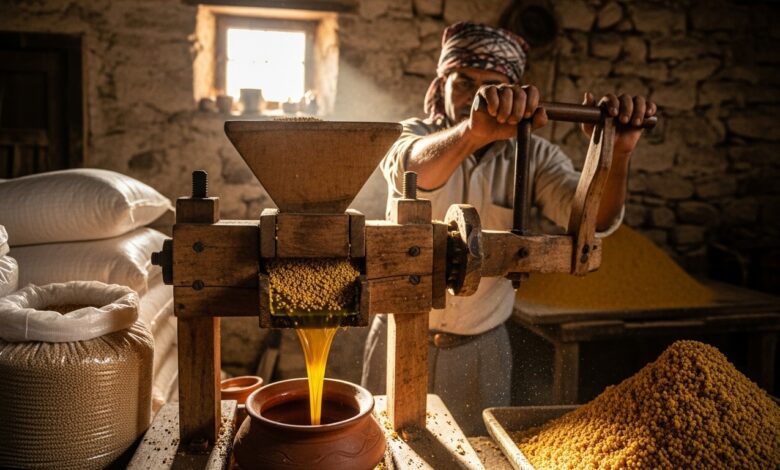
- Cleaned seeds are fed into a cold press oil extraction machine.
- This method retains the natural nutrients, flavor, and aroma of mustard oil.
- Filtration & Clarification:
- Extracted oil passes through filtering units to remove remaining solids and impurities.
- The process ensures pure, clear, and high-quality oil suitable for consumer use.
- Storage: o Oil is stored in stainless steel tanks under hygienic conditions to preserve freshness and prevent contamination.
- Packaging & Labeling: o Oil is filled into pre-sterilized bottles using a packaging machine.
- Bottles are labeled with branding, product information, and quality certification.
- Quality Control: o Each batch undergoes testing for purity, acidity, and shelf-life compliance.
- Ensures the product meets consumer safety and quality standards.
- Distribution: o Finished products are distributed to local markets, retail shops, and wholesalers.
- Priority is given to local demand while planning expansion to neighboring districts.
Key Advantages of This Process:
- Preserves natural nutrients and aroma of mustard oil
- Hygienic and standardized production
- Efficient workflow minimizes waste and maximizes yield
- Directly supports local farmers and promotes economic growth in District Badin
Quality & Control (Q&C) Protocols and Steps
Our mustard oil production follows strict Q&C protocols to ensure purity, safety, and consistency. Raw mustard seeds are first inspected for quality and cleaned to remove impurities. Oil is extracted using coldpress technology, retaining nutrients and flavor. The extracted oil undergoes filtration and clarification to remove solids. Each batch is tested for acidity, moisture, and shelf-life. Hygienic storage in stainless steel tanks and automated packaging and labeling ensures product safety. Continuous monitoring at every stage maintains quality standards, guaranteeing a premium, reliable product for consumers.
Staffing and Management
- No Name of Designation Role and Responsibilities
Oversee overall operations, coordinate staff, manage finances, and ensure
- Project Manager
project targets are met.
Supervise oil extraction, filtration, and packaging processes; maintain
- Production Supervisor
production schedule and quality.
Quality Control Test raw materials and finished products for purity, acidity, and compliance 3
Officer with standards.
Marketing & Sales Develop marketing strategies, manage sales, establish distribution channels,
4
Officer and promote the brand.
Accountant / HR Maintain financial records, manage payroll, handle HR activities, and track
5
Officer operational expenses.
Operate cold press, filtration, and packaging machines; perform routine
6 Machine Operator(s)
maintenance and troubleshooting.
Packaging & Labeling Ensure accurate bottling, labeling, and packaging of finished products for 7
Staff distribution.
Support production, cleaning, storage, and miscellaneous tasks in daily
8 Labor / Helper Staff
operations.
Market Strategy
Our business, “Sarson ka Tail ka Ghanna”, targets both local and regional consumers who demand highquality mustard oil. Key strategies include:
- Direct Sourcing & Branding: Highlighting locally grown mustard seeds and pure cold-pressed oil to attract quality-conscious customers.
- Retail & Wholesale Distribution: Partnering with grocery stores, supermarkets, and local markets in Badin and neighboring districts.
- Digital Marketing: Leveraging social media and online platforms for awareness, promotions, and direct-to-consumer sales.
- Competitive Pricing: Offering affordable pricing compared to imported and low-quality packaged oils while maintaining high quality.
Risk Analysis & Mitigation
Risk Impact Mitigation Strategy
Raw Material Shortage High Establish long-term contracts with local farmers and maintain buffer stock.
Regular maintenance schedules and provision of backup tools and spare
Machinery Breakdown Medium
parts.
Risk Impact Mitigation Strategy
Focus on superior quality, branding, and customer engagement to
Market Competition Medium
differentiate.
Price Fluctuations of Mustard Monitor market trends, negotiate fair prices, and maintain small reserve Medium Seeds stock.
Train staff, define clear roles, and implement performance monitoring
Operational/Staff Challenges Medium systems.
Regulatory & Hygiene Follow local food safety standards, conduct regular quality audits, and High
Compliance document procedures.
By adopting a well-defined market strategy and proactive risk mitigation plan, the project ensures sustainable growth, consistent production, and long-term profitability, while contributing to local employment and farmer livelihoods.
Type of Sale
Our business, “Sarson ka Tail ka Ghanna”, will use a multi-channel sales approach to maximize market reach and revenue: 1. Retail Sales (Offline):
- Products will be sold through local grocery stores, supermarkets, and vegetable markets in District Badin and nearby areas.
- Focus on convenience and accessibility for everyday consumers.
- Wholesale Sales: o Partner with distributors and wholesalers to supply bulk orders to retailers and small businesses.
- This will help scale production and reach multiple markets efficiently.
- Online Sales (E-commerce / Social Media):
- Use social media platforms (Facebook, Instagram) and local online marketplaces to promote and sell directly to consumers.
- Enables brand awareness, digital marketing campaigns, and delivery to a wider audience.
- Offline Direct Sales: o Participate in local fairs, exhibitions, and farmer markets to engage directly with customers, provide product samples, and build trust in the brand.
Combining retail, wholesale, and online/offline direct sales ensures broad market coverage, strengthens brand visibility, and increases revenue potential while supporting local producers and meeting consumer demand for high-quality mustard oil.
Distribution & Handling
Efficient distribution and proper handling are crucial to maintain the quality, hygiene, and timely delivery of “Sarson ka Tail ka Ghanna”. Our plan includes:
- Storage & Inventory Management:
- Finished products will be stored in clean, temperature-controlled storage tanks and warehouses to prevent contamination and maintain freshness.
- Inventory management software will track stock levels, batch numbers, and shelf-life to avoid losses.
- Transportation:
- Products will be transported in sealed, food-grade containers using dedicated delivery vehicles.
- Careful handling during loading and unloading will prevent spillage, breakage, or contamination.
- Distribution Channels:
- Retail Stores: Deliver to local grocery shops, supermarkets, and farmer markets in Badin and neighboring districts.
- Wholesale Distributors: Supply bulk orders to distributors for wider market reach.
- Direct Delivery to Customers: For online orders, products will be packaged securely for home delivery.
- Quality Assurance During Distribution:
- Regular inspections and adherence to hygiene standards during transportation and storage. o Tracking of batch numbers ensures traceability in case of complaints or recalls.
This system ensures that mustard oil reaches customers in optimal quality, maintains brand reputation, and supports consistent market supply while minimizing losses and damage.
Inventory Management
Effective inventory management is crucial for the smooth operation of “Sarson ka Tail ka Ghanna” and to ensure consistent supply, reduce wastage, and maintain product quality. Our approach includes: 1. Raw Material Inventory:
- Maintain a buffer stock of mustard seeds and packaging materials to prevent production delays.
- Regularly monitor quality and shelf-life of seeds to avoid spoilage.
- Work-in-Progress (WIP) Inventory: o Track oil extraction and filtration batches to manage production schedules efficiently.
- Ensure timely movement from processing to storage without overstocking.
- Finished Goods Inventory:
- Store bottled mustard oil in hygienic, temperature-controlled storage tanks.
- Implement a first-in, first-out (FIFO) system to minimize expiry or quality degradation.
- Inventory Tracking System:
- Use a simple digital inventory management system to record stock levels, batch numbers, sales, and returns.
- Helps in forecasting demand, planning procurement, and reducing operational losses.
- Periodic Audits:
- Conduct weekly and monthly inventory checks to reconcile physical stock with records. o Identify discrepancies early to maintain accountability and transparency.
Efficient inventory management ensures continuous production, reduces losses, maintains product quality, and supports timely delivery to retail, wholesale, and online customers, strengthening overall business operations.
Target Market and Customer
The target market for “Sarson ka Tail ka Ghanna” focuses on consumers who value high-quality, pure, and locally produced mustard oil. Our strategy segments the market into three main categories:
- Local Households:
- Residents of District Badin and nearby rural and urban areas who use mustard oil as a staple cooking ingredient.
- Preference for pure, nutritious, and safe oil for daily consumption.
- Retailers and Small Businesses: o Grocery stores, supermarkets, and local shops that require consistent supply of quality mustard oil for resale.
- Businesses looking for branded, attractive packaging to meet consumer demand.
- Wholesale Distributors and Institutional Buyers: o Bulk buyers including restaurants, catering services, and regional distributors.
- Focused on larger quantities, cost-effectiveness, and reliable delivery schedules.
Customer Characteristics:
- Quality-conscious and health-aware consumers
- Price-sensitive but willing to pay slightly more for purity and hygiene
- Preference for locally produced and traceable products
Market Strategy:
- Use branding, packaging, and social media awareness campaigns to attract quality-focused customers.
- Ensure direct supply and consistent availability for retailers and distributors to build long-term relationships.
Targeting these segments ensures stable demand, strengthens local supply chains, and maximizes the impact of the business on employment and local agricultural development in District Badin.
Key Challenges & Way Forward
- Raw Material Availability:
- Challenge: Seasonal fluctuations and inconsistent supply of mustard seeds from local farmers.
- Way Forward: Establish long-term agreements with multiple local farmers, maintain buffer stock, and encourage contract farming to ensure consistent supply.
- Market Competition:
- Challenge: Competition from low-quality local oils and imported brands.
- Way Forward: Differentiate through high-quality, cold-pressed mustard oil, hygienic packaging, and strong branding to attract quality-conscious consumers.
- Operational Risks:
- Challenge: Machinery breakdown or inefficiencies affecting production.
- Way Forward: Implement routine maintenance schedules, provide staff training, and maintain spare parts to minimize downtime.
- Financial Constraints:
- Challenge: Limited capital for scaling production or marketing.
- Way Forward: Efficient budget planning, phased expansion, and leveraging UNIDO Paidar Grant support to invest in machinery, marketing, and working capital.
- Regulatory & Quality Compliance:
- Challenge: Meeting food safety and hygiene standards.
- Way Forward: Implement strict Q&C protocols, regular testing, and compliance with local regulations to maintain trust and brand reputation.
By proactively addressing these challenges through strategic planning, quality assurance, and strong partnerships, the project ensures sustainable growth, employment generation, and a reliable supply of high-quality mustard oil in District Badin.
Direct and Indirect Job Creation
The “Sarson ka Tail ka Ghanna” project will generate both direct and indirect employment opportunities in District Badin, contributing to local economic growth:
- Direct Jobs:
- Production Staff: Machine operators, laborers, and helpers for oil extraction, filtration, and packaging (6–8 persons).
- Quality Control & Supervisory Staff: QC officers, production supervisors, and project manager (3– 4 persons).
- Marketing & Sales Staff: Marketing officers, sales representatives, and delivery personnel (2–3 persons).
- Administrative Staff: Accountant, HR, and administrative support (2 persons). Estimated Direct Jobs: 13–17 positions
- Indirect Jobs:
- Farmers: Local mustard seed growers supplying raw materials (50–60 farmers).
- Transport & Logistics: Drivers, loaders, and distribution agents for raw material and finished product movement.
- Suppliers & Vendors: Packaging, labeling, machinery maintenance, and utilities providers.
Estimated Indirect Jobs: 50–70 positions
The project not only reduces unemployment but also empowers local farmers, engages women in production and packaging, strengthens the supply chain, and stimulates the local economy in District Badin.
SWOT Analysis – “Sarson ka Tail ka Ghanna”
| Category Details – High-quality, cold-pressed mustard oil with superior taste and nutrients. – Locally sourced raw materials support farmers and ensure traceability. Strengths – Hygienic production and modern packaging enhance consumer trust. – Multi-channel sales (retail, wholesale, online/offline) ensure wide market coverage. – Initial dependence on seasonal mustard seed availability. Weaknesses – Limited brand recognition in early stages. – Small-scale operation may restrict production capacity initially. – Growing consumer demand for pure, healthy cooking oils. – Expansion potential to neighboring districts and online markets. Opportunities – Government and UNIDO support for small-scale agro-industrial enterprises. – Potential for value-added products (flavored oils, gift packs). – Competition from low-cost local oils and imported brands. – Price fluctuations of mustard seeds affecting raw material cost. Threats – Machinery breakdowns or supply chain disruptions. – Regulatory changes or strict compliance requirements.
|
By leveraging strengths, addressing weaknesses, capitalizing on opportunities, and mitigating threats, “Sarson ka Tail ka Ghanna” is positioned for sustainable growth, quality production, and local economic impact in District Badin.
Three Years, Business Growth, Target vs Achievement,
Year 1 – Business Growth Plan
| Initial Capital SRSO Grant Self Contribution Year 1 Sale Year 1 Profit Net Capital S.No (PKR) (PKR) (PKR) (PKR) (PKR) Year 1 (PKR) 1 3,455,000 2,000,000 1,455,000 2,500,000 500,000 3,955,000
| ||||
| Year 2 – Business Growth Plan | ||||
| Initial SRSO Self S.No Capital Grant Contribution (PKR) (PKR) (PKR) | Year 1 Profit (PKR) | Year 2 Sale (PKR) | Year 2 Profit (PKR) | Net Capital Year 2 (PKR) |
| 1 3,955,000 0 3,955,000
| 500,000 | 3,500,000 | 700,000 | 4,655,000 |
| Year 3 – Business Growth Plan | ||||
| Initial SRSO Self S.No Capital Grant Contribution (PKR) (PKR) (PKR) | Year 1 & 2 Profit (PKR) | Year 3 Sale (PKR) | Year 3 Profit (PKR) | Net Capital Year 3 (PKR) |
| 1 4,655,000 0 4,655,000
| 1,200,000 | 5,000,000 | 1,000,000 | 5,655,000 |